


Volga
Volga is a second-order option Greek that measures the rate of change of vega (the option's sensitivity to changes in implied volatility) with respect to changes in implied volatility. Volga is also known as "Vomma".
Volga is important because it tells traders how much an option's value will change as the implied volatility changes. If an option has a high Volga, its value will be more sensitive to changes in implied volatility, which means that the option will be more expensive or less expensive depending on the volatility levels.
Like other option Greeks, Volga can be used to manage risk in options trading. Traders can use Volga to adjust their positions to changes in implied volatility, which can help them to protect their portfolios from adverse moves in the market.
The chart ahead indicates the vega values for different implied volatilities, with vega 40 indicating Nifty option vega at 40% volatility, so on. Days to expiry for the option is 2 days, for ATM strike = 17750.
Nifty Options
Days to expiry (DTE) = 2
ATM strike = 17750
Similarly, the second chart indicates Nifty option vega at different implied volatilities with DTE = 16.
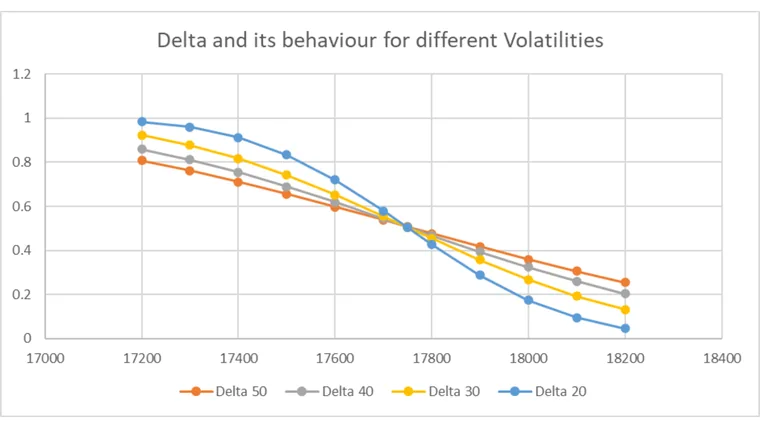
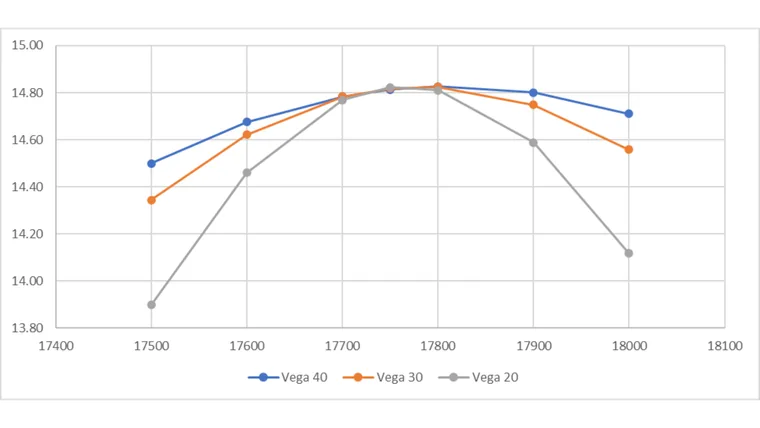
On careful observation we realise that
1. ATM vega is constant and maximum.
2. As volatility increases, vega of OTM and ITM options increase, approaching the ATM vega level.
3. As DTE increases, the vega value for any option increases, implying
Closer to option expiry, VEGA impact reduces.
4. As volatility increases, the vega curve flattens out.
In above example ATM VEGA with DTE = 16 is about 14.80; while ATM VEGA with DTE = 2 is 5.25.
Frequently asked questions
What is Volga?
Volga, which is also known as Vomma, or volatility gamma, is a second-order option Greek that measures the rate of change of vega (the option's sensitivity to changes in implied volatility) with respect to changes in implied volatility.
How is Volga for an option calculated?
Volga measures the curvature of an option's vega with respect to changes in implied volatility.
Volga = dVega/dVolatility
The Black-Scholes option pricing model forms the base for the computation of variety of Option Greeks ranging from Delta, Gamma to Volga, Vanna, to name a few.
What are the advantages of Volga, option Greek?
Volga helps to quantify the risk exposure of an option to changes in implied volatility, which can be useful for managing risk in options portfolios. By understanding the impact of changes in implied volatility on an option's price and risk profile, traders can make more informed trading decisions and adjust their positions to better manage risk.
What are the disadvantages of Volga, option Greek?
Volga only measures the curvature of an option's vega with respect to changes in implied volatility. As a result, it does not provide a complete picture of the risk exposure of an options position. To get a more comprehensive view of an option's risk, traders must consider other Greeks, such as delta, gamma, vega, and theta, with other second order greeks too.
Examples are for education only, not investment advice. Derivatives trading carries risk; read all scheme and risk documents before trading.