


Short Iron Condor option strategy
Short Iron Condor sells an OTM Put and an OTM Call and buys further OTM options on both sides as protection. It collects premium while the underlying stays inside a range, with the risk capped on both sides.
Payoff at expiry
Nifty, lot size 65 · Nifty future 22,946 · 19 Oct 2026Legs
| Action | Option | Strike | Lots | Qty | Premium |
|---|---|---|---|---|---|
| BUY | OTM Put | 22,850 | 1 | 65 | ₹62.88 |
| SELL | OTM Put | 22,900 | 1 | 65 | ₹82.63 |
| SELL | OTM Call | 23,000 | 1 | 65 | ₹79.50 |
| BUY | OTM Call | 23,050 | 1 | 65 | ₹60.53 |
How it works
- Buy 1 OTM put at the 22,850 strike for ₹62.88, paying the premium.
- Sell 1 OTM put at the 22,900 strike for ₹82.63, collecting the premium.
- Sell 1 OTM call at the 23,000 strike for ₹79.50, collecting the premium.
- Buy 1 OTM call at the 23,050 strike for ₹60.53, paying the premium.
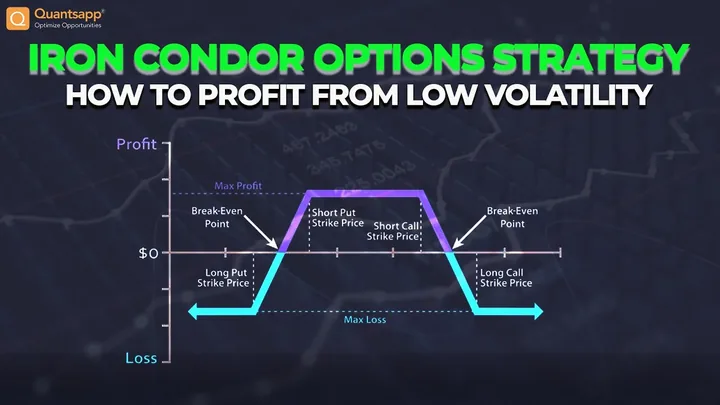
- You receive a net ₹2,517 upfront for the position. This is the most you can make.
Below 22,861 you lose, up to ₹733.
Between 22,861 and 23,040 you profit, up to ₹2,517.
Above 23,040 you lose, up to ₹733.
Set-up: Buy 1 lot deep OTM Put, Sell 1 lot OTM Put, Sell 1 lot OTM Call and Buy 1 lot deep OTM Call with same expiration date.
What happens if Nifty moves
Profit or loss at expiry| Nifty at expiry | Move | Profit / loss |
|---|---|---|
| 21,550 | −6% | −₹733 |
| 22,250 | −3% | −₹733 |
| 22,700 | −1% | −₹733 |
| 22,950 | Unchanged | +₹2,517 |
| 23,200 | +1% | −₹733 |
| 23,650 | +3% | −₹733 |
| 24,300 | +6% | −₹733 |
How the Greeks affect it
When to use
When you expect the underlying to stay range bound till expiry and implied volatility is relatively high.
- Earns from time decay and range bound markets.
- Risk is capped on both sides unlike a short strangle.
- Lower margin than naked selling.
Things to watch
- Reward is small compared to the risk.
- A sharp move either way leads to the maximum loss.
- Four legs means more brokerage and slippage.
Short Iron Condor: questions
What is a Short Iron Condor strategy?
Short Iron Condor sells an OTM Put and an OTM Call and buys further OTM options on both sides as protection. It collects premium while the underlying stays inside a range, with the risk capped on both sides.
When should you use a Short Iron Condor?
When you expect the underlying to stay range bound till expiry and implied volatility is relatively high.
How do you set up a Short Iron Condor?
Buy 1 lot deep OTM Put, Sell 1 lot OTM Put, Sell 1 lot OTM Call and Buy 1 lot deep OTM Call with same expiration date.
What is the maximum profit of a Short Iron Condor?
Limited to the net credit received, if the underlying stays between the two sold strikes at expiry.
What is the maximum loss of a Short Iron Condor?
Limited to the difference between the adjacent strikes less the net credit, if the underlying moves beyond either outer strike.
What is the breakeven of a Short Iron Condor?
With Nifty at 22,946, the example on this page breaks even at 22,861 and 23,040 at expiry.
Watch: Short Iron Condor videos
 12:15Iron Condor vs Short Strangle: Hedging and Adjustments
 14:02Iron Condor with AI Volatility Insights (Hindi)
 21:43Iron Condor Strategy for Low Volatility Markets (Hindi)