What is implied volatility; how can it affect Options, and how can one make money using it: Shubham Agarwal explains
Implied volatility or IV, as it is popularly known, is a critical data point in Options trading. As the price moves, the IV also moves. Movement in IV impacts the premium.
##Improve profitability in Options by tracking implied volatility##
Implied volatility or IV, as it is popularly known, is a critical data point in Options trading. As the price moves, the IV also moves. Movement in IV impacts the premium. So, IV has the capacity to move the options premium even as the price of the underlying or the time remain unchanged.
Sounds a bit important right?
So, let us understand IV better, its impact, and the opportunities it offers, along with cautions with those impacts.
##What is IV?##
Implied Volatility (IV) is the volatility implied by the options premium. Options premium is made up of five factors.
##How is IV different from volatility?##
IV is Option traders’ estimation of volatility for the rest of the life of the Options. This means it is forward looking, or it is Option traders’ forecasted volatility.
Now, that we know this, we should also learn two crucial aspects of IV.
##1. IV is directly related to Options Premium##
Rise in IV means rise in premium. Fall in IV leads to fall in premium (once again this the chicken and egg dilemma).
But, the important impact that we need to learn is that Options Premium can fall without any change in price or time whatsoever if IV (Option Traders’ Forecasted Volatility) goes down.
Similarly, upon expectation of higher volatility, the Option Premiums can go up with no move in Price in a Day. This is something we see during results season, when before results Option Premiums are very high and it drops right after results.
##2. IV is mean reverting##
IV of any option, when plotted on a chart, will never have a trending move. Unlike stocks that can go up from Rs 10 to Rs 100 to Rs 1,000, IV generally moves in ranges.
Now that we know what IV is and its impact along with the range-bound characteristic, let us figure out how it can affect Options and how one can make money (and not lose money) using IV.
##Make money##
The range-bound characteristic will push the IV up from the lower extreme. If the IV rises from the bottom it will push the premiums up. So, there is an opportunity when the IV is anywhere close to the previous low.
In such a situation, one can buy Options ― Call Options for bullish trades and Put Option for bearish trades.
If in case the range-bound characteristic pushes the IV up, regardless of whatever happens to the price, the Option will make a profit from the rise in IV.
##Not lose money##
The range-bound characteristic would also push the IV down from the upper extreme. This would push our Option prices also lower.
It could happen that we bought a Call, and the underlying moved up today, but we could not make the expected amount of money due to fall in IV.
So, if IV is closer to the previous high, it would be wise to take a spread trade. Along with buying a call or put option, sell a higher call or lower put of 3-4 strikes away from the strike of the option bought.
Now if the IV drops, the IV of the Option bought and the Option sold, both will drop together, thereby to some extent neutralising the impact of the drop in IV (and consequently the drop in premium).
While this strategy reduces profits, it more or less maintains profitability (return on investment) by negating the adverse impact of IV.
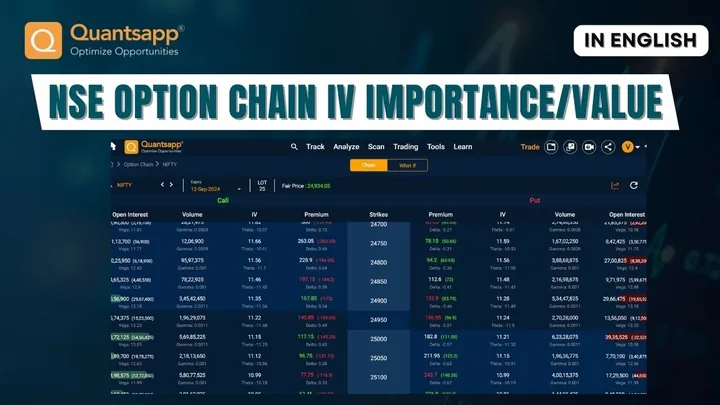
This way tracking IV can help improve profitability. IV charts of all F&O symbols are easily available on Option Analytic applications. Also, one easy way is to use index of Nifty Options IVs, India VIX. The chart of India VIX is available on NSEIndia.com. One can practice the same using India VIX as proxy for option-wise IV.
Learn and read more about candlesticks patterns from Quantsapp classroom which has been curated for understanding of sgx nifty future from scratch, to enable option traders grasp the concepts practically and apply them in a data-driven trading approach.
First published on 10 Sep 2022: prices, lot sizes and expiries are those of that time. They are illustrations for education only, not investment advice. Derivatives trading carries risk; read all scheme and risk documents before trading.