Get better returns with implied volatility
Range bound characteristic would also push the IV down form the upper extreme. This would push our Option Prices also lower.
F&O Cues
Shubham Agarwal
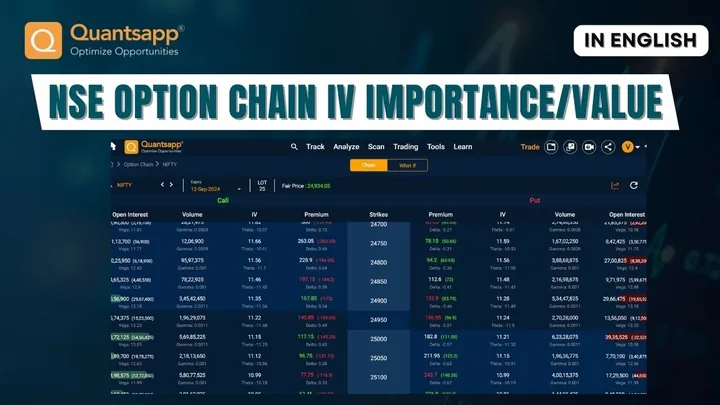
IV or Implied Volatility is the Volatility implied by the Option Premium. Option Premium is made up of 5 factors.
Premium = Formula using (Stock/Index Price, Strike Price, Interest Rate, Volatility, Time to Expiry)
Option Premium is known and we also know
-
Stock Price
-
Strike Price
-
Interest Rate
-
Time to Expiry
Now for the Premium trading in the market finding #5. Volatility with rest of the 4 known inputs is just a mathematical equation.
Since such back calculated Volatility is Implied by the Premium hence it is called Implied Volatility.
How is IV different from Volatility?
IV is Option Trader’s approximation of Volatility for the rest of the life of the Option. This means it is forecasted Volatility by traders.
Now that we know this, we should also learn 2 crucial aspects of the IV.
- IV is directly related to Option Premium
Rise in IV means rise in Premium, Fall in IV leads to Fall in Premium. But, the important impact that we need to learn is that Option Premium can lower without no change in Price or Time whatsoever if IV (Option Traders’ Forecasted Volatility) goes down.
Similarly, upon expectation of higher Volatility the Option Premiums can go up with no move in Price in a Day. We have seen the same happening just recently during union elections 2024. Option Premiums were very high, and it dropped right after Results last week.
- IV is Range Bound
What I mean is that IV of any option when plotted on a chart will never have a trending move. Unlike stocks that can go up from 10 to 100 to 1000, IV generally moves in ranges.
Better Returns via Making More Money:
Range bound characteristic would push the IV Up from the lower extreme We all know the impact that if the IV rises from the bottom it will push the premiums up. So, Opportunity presents itself when the IV is anywhere close to previous low.
If IV comes closer to higher extreme, go ahead and Buy Call for Bullish trades.
If in case range bound characteristic pushes the IV up, regardless of whatever happens to the price the Option will get Profit from rise in the IV.
Not Lose Money:
Range bound characteristic would also push the IV down form the upper extreme. This would push our Option Prices also lower.
So, if IV is closer to Previous high, it is wise to take a spread trade. Along with Buying a Call or Put Sell Higher Call or Lower Put of 3-4 strikes away from the Strike of the option Bought.
Now if the IV drops, the IV of Bought Option and Sold Option both will drop together, thereby to some extent neutralizing the impact of the drop in IV (thereby drop in Premium).
Sure, this strategy reduces profits, but it more or less maintains profitability (returns on investment) by negating the adverse impact of IV.
One easier way to approximate is to use index of Nifty Options IVs, India VIX. One could practice the same using India VIX as proxy for option wise IV.
First published on 22 Jun 2024: prices, lot sizes and expiries are those of that time. They are illustrations for education only, not investment advice. Derivatives trading carries risk; read all scheme and risk documents before trading.