


Option Greeks Calculator
Pick any Nifty, Bank Nifty, Sensex or stock option to see its delta, gamma, theta and vega, per unit and per lot in rupees. Move the sliders to see what a market move, a volatility change or a few days of time decay would do to it.
Loading NIFTY…
See delta, theta and vega for every strike live, and set an alert or an automatic order when a Greek crosses your level →Advanced: vanna, charm, volga
What if…
What-if values and the chart use the Black-76 model on the future (rate as set, calendar days), so they can differ slightly from the app's live Greeks.
What the option Greeks tell you
An option's premium moves for three reasons: the underlying moves, time passes, and the market's expectation of volatility changes. Each Greek isolates one of them, so you can see what will help or hurt a position before it happens.
How the Greeks behave
| Greek | At the money | Deep in / out of the money | Near expiry |
|---|---|---|---|
| Delta | About 0.50 (−0.50 for puts) | Close to 1 / close to 0 | Rushes towards 0 or 1 |
| Gamma | Highest | Low | Spikes for at-the-money strikes |
| Theta | Most negative | Small | Decay speeds up sharply |
| Vega | Highest | Low | Falls as time runs out |
Greeks of a whole position
Greeks add up across legs. A short straddle has near-zero delta but large negative gamma and positive theta; an iron condor caps the gamma and vega risk with bought wings. To see the net Greeks of a strategy and how they change with price and time, build it in Option Architect.
Option Greeks on video
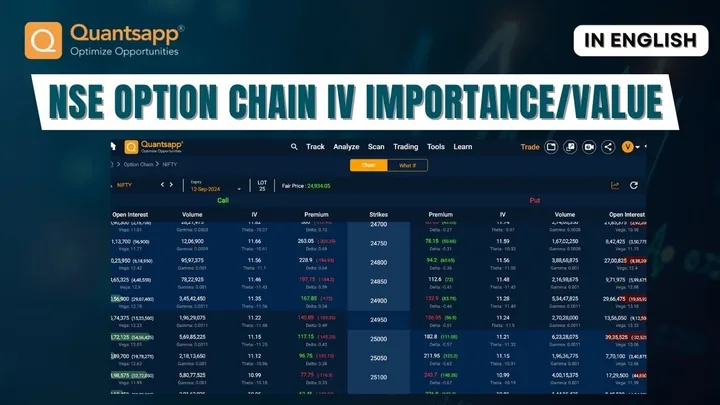 20:09Implied Volatility in the Option Chain: Why IV Matters
 23:24How to Trade the Option Chain, with Triggers
 24:00Option Chain, OI, Volume and Greeks: Reading Analytics
Greeks for every strike, live
See delta, gamma, theta and vega across the whole option chain, the net Greeks of your strategy in Architect, and place orders triggered by Greeks with ATO. One free account, no payment.
Used by 17 lakh+ traders · Real-time NSE & BSE · No payment required
Create free account- Max pain / option pain
- Option chain + Greeks
- Open interest analysis
- Multi-strike OI chart
- PCR & Modified PCR
- Strategy builder
- FII / DII data
- IV analysis
- Futures OI
- OI buildup
- Trade with 16 brokers
- Alerts & triggers
Frequently asked questions
What are option Greeks?
Option Greeks measure how an option's price reacts to the things that move it: delta to the underlying price, gamma to changes in delta, theta to the passing of time, and vega to implied volatility. Traders use them to size positions and to see what can hurt a trade before it does.
Why do these Greeks differ from other calculators?
The live values are the Quantsapp app's own Greeks for the contract. Calculators differ because of the interest rate (the app uses 0%), whether the underlying is the spot index or the future (the app prices on the future), and how time to expiry is counted. The what-if charts use textbook Black-76 on the future.
What do Greeks per lot mean?
Greeks are quoted per unit of the underlying. Multiplying by the lot size gives the rupee effect on one lot: a NIFTY option with theta −12 and a lot of 65 loses about ₹780 per lot per day.
How do I find the implied volatility of an option?
Use the "IV from premium" tab: enter the futures price, strike, days to expiry and the option's price, and the calculator solves for the volatility that produces that premium.
Which Greek matters most for option sellers?
Theta is the income, but gamma and vega are the risks: a fast move (gamma) or a jump in volatility (vega) can wipe out weeks of decay. Hedged strategies such as iron condors cap those risks.
Related tools
Live Greeks are the Quantsapp app's values for the contract; model values use Black-76 on the future. For information only, not investment advice. Disclaimer